

Choosing between freelancing, remote gigs, and nearshore roles isn’t about labels or contract types. It’s about your operating context: how you work, how you grow, how you’re evaluated, and whether your career has continuity or constant resets.
This article starts from a clear point of view. Nearshore isn’t an in-between option, it’s a structured career model built for long-term contribution, progression, and belonging.
Choose a home, not hotels. That’s the real decision behind modern tech careers.
We’ll cut through freelance, remote, and nearshore roles in Europe to show what each model actually delivers when it comes to stability, growth, and flexibility, so you can choose intentionally, not accidentally.
WHAT YOU’LL FIND IN THIS ARTICLE:
• How different work models shape your day-to-day operating context
A clear breakdown of how freelancing, remote gigs, and nearshore roles differ in stability, expectations, and long-term career continuity.
• What nearshore roles actually deliver beyond location and pay
Learn how onboarding, retention, security, and People Experience change the real work experience inside product teams.
• How to evaluate offers using practical, verifiable signals
Concrete questions, metrics, and artifacts you can request to assess predictability, growth paths, and delivery stability before you commit.
What nearshore developer roles mean
Nearshore developer roles connect engineers to product teams in neighbouring countries with time-zone overlap and cultural alignment. More than proximity, nearshore is about long-term team integration: joining a real delivery context with shared goals, rhythms, and responsibility.
These roles usually include structured onboarding and clear legal frameworks, with payroll handled by the nearshore partner so engineers can focus on delivery and growth, not administration.
Most nearshore engagements fall into three models: monthly FTE (full-time equivalent), part-time retainers, and fixed-scope POCs (proofs of concept). Monthly FTEs support sustained contribution and progression. Retainers fit ongoing advisory needs. POCs are short, outcome-driven engagements to validate fit.
The day-to-day experience also differs from freelancing. Freelancers balance multiple clients. Nearshore engineers commit to one product team, follow its sprint cadence, and share long-term ownership. Compared to generic remote roles in Europe, nearshore setups tend to offer clearer expectations around feedback, continuity, and career development.
Security and compliance are part of the operating context. While requirements like NDAs or access controls may extend hiring slightly, they enable trust, protect IP, and allow engineers to work closer to core systems, where impact and learning are higher.
Key criteria to evaluate offers
Use these three criteria to compare options before taking a job:
Predictability and ramp speed matter
Start-date predictability is crucial for sprint planning and executive reviews.
Ask vendors for average time-to-start, interview-to-offer timelines, and the expected first 4-week ramp. Reliable start dates reduce late-stage scrambling.
Practical ask: get the vendor’s median time-to-start and one example of a start that met the timeline. If they can’t provide timelines, treat that as a transparency issue.
Long-term retention and knowledge continuity
High churn increases technical debt and slows delivery.
Request retention metrics or case studies showing multi-month placements. Longevity means fewer regressions and better code ownership.
Practical ask: request the percentage of consultants who stay beyond six months on the same product and one brief example of a retained placement that delivered measurable outcomes.
Involve Security and Procurement early.
Verify ISO certifications, payroll compliance, and sample contract language. A procurement-friendly vendor speeds approvals and reduces surprises.
Practical ask: ask for sample contract clauses around IP, access control, and data handling. If procurement can’t approve quick redlines, hiring will stall.
Got an offer that sounds too good? A job proposal where something feels off? Our blog post, Unmasking LinkedIn Scams: How to Protect Yourself in the Job Hunt, helps talent like you navigate through common scams that might show up during your job search.

Why engineers are choosing nearshore roles now
Desire for stability and career growth
Freelance income can spike, but it swings. Nearshore roles offer steady monthly pay and clearer career tracks, supported by active structure like mentorship, regular feedback, and performance reviews, not just time spent on a project.
Imagine joining a product team, shipping features for six months, and getting invited to own a module. That continuity builds domain expertise. It also opens promotion paths -> tech lead, senior engineer, or platform role.
Example: a mid-level engineer who moved from short contracts to a nearshore FTE reported steady mentorship and a promotion pathway after nine months. They went from fixing tickets to designing a feature and then leading its rollout. That progression rarely happens in short freelance contracts.
When you interview, ask hiring teams about mentorship, promotion criteria, and how performance reviews are scheduled. If they can’t describe a 6–12 month growth path, treat that as a red flag.
Better work–life balance with predictable schedules
Time-zone alignment reduces late-night calls and weekend firefights.
Nearshore work usually requires agreed overlap hours and clearer on-call rules. That structure protects evenings and weekends.
Compare this to farshore or global freelance gigs where you might work opposite hours to please clients. That pattern burns people out. If you value predictable evenings and focused mornings, insist on explicit overlap windows in the contract.
Quick question to ask recruiters: “What are the mandatory overlap hours and on-call expectations?” If the answer is vague, don’t assume it will improve after you sign.
Access to meaningful long-term projects
Nearshore engineers often join stable product squads and ship end to end. That continuity enables real ownership, not just over tasks, but over outcomes, and is a key driver of long-term team stability and retention.
That ownership matters for craft and career satisfaction. You’ll see code reviews, architecture discussions, and long-term backlog work instead of discrete task tickets.
When you interview, ask for the onboarding schedule and first 30-day responsibilities. Expect a clear answer. Vendors that place people on meaningful projects usually publish onboarding docs and People Experience role details.
Moving abroad can be a challenging career decision, but you don’t have to do it alone or go in blind. Read this blog post written by one of our colleagues and get to know some reasons Why Portugal Can Be Your Next Career Step.

Trade-offs: Freelance vs Nearshore vs Remote gigs
Here are the practical trade-offs you’ll face:
Pay variability versus predictable monthly income
Freelancers can earn more in peak months. But income is uneven. Nearshore roles provide steady monthly billing.
Do the math: create a 6–12 month burn-rate plan comparing average freelance monthly earnings (after taxes and downtime) with nearshore monthly FTE. Include paid time off, employer taxes, and benefits.
Mini case: if your freelance average is $6,000 a month but includes two months of downtime per year and no paid leave, your annual net may be similar to a $4,500 monthly FTE with paid time off and benefits. Run the numbers.
Autonomy versus team integration and career ladder
Freelancers pick projects and set rates. They enjoy autonomy but often miss code ownership and mentoring. Nearshore consultants work inside teams with code review cadences, mentoring programs, and formal feedback cycles. That structure drives faster skill growth.
Interview ask: request examples of recent promotions or mentorship pairings. If you hear “we’ll figure it out,” that’s a sign the vendor treats growth as informal rather than systematic.
Short-term flexibility versus long-term stability
Short remote gigs are great for travel and trying new stacks. Nearshore suits engineers aiming for sustained impact and steady income.
Map your next 12 months: are you saving for relocation or building a long-term tech track? Choose the model that matches those milestones.
Time-zone friction and coordination costs
Freelancers working with distant time zones trade flexibility for odd hours. Nearshore roles reduce coordination costs and often match working hours to your calendar. That can mean fewer context switches and better focus.
Ask about expected overlap windows and meeting frequency. A clear schedule is a simple, practical sign of healthy teamwork.
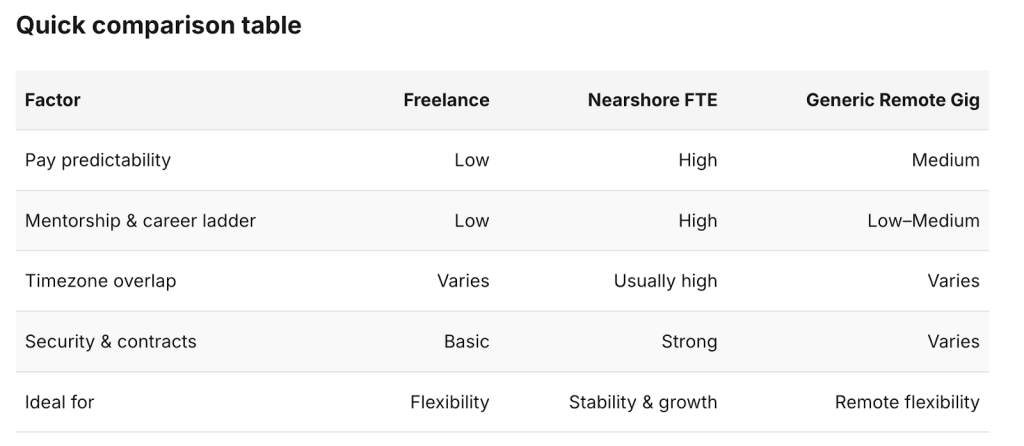
(Use this table as a starting point. Add your own weightings based on personal priorities.)
How to vet offers quickly
Use this short checklist during interviews.
– Ask for the 30-day onboarding schedule.
– Request retention metrics or case examples.
– Confirm expected overlap hours and on-call rules.
– Ask for sample onboarding docs and first-sprint responsibilities.
– Verify security certifications and payroll compliance.
If a vendor hesitates, probe why. A confident, people-centered partner answers these quickly.
Practical script: “Can you send a one-page onboarding timeline and a recent retention metric? I use those to brief my manager and security team.”
Companies that respond with clear intentions are easier to trust: “We want people who stay and do their best work.”
This is a People Experience statement you should be able to verify as a concrete plan, not just a slogan.

How KWAN helps engineers and hiring teams
KWAN is built around a people-first model. Every engineer is supported by a dedicated People Experience Partner, ensuring continuous mentorship, regular feedback, and long-term development rather than passive project allocation.
That focus on people enables a predictable delivery system. KWAN supports clients with structured onboarding templates, clear ramp timelines, and retention metrics, all backed by a documented three-week recruitment cadence and a proactive talent pipeline.
For engineers, this means predictable monthly billing and a clear growth framework. For hiring teams, it means transparency, planning confidence, and teams that integrate faster and stay longer. When evaluating nearshore partners, ask for these explicitly and compare them side by side.
Conclusion, takeaways and next steps
Nearshore roles sit between freelance freedom and generic remote gigs. They give steady pay, product ownership, and time-zone sanity without sacrificing remote flexibility.
If you value predictability, retention, and career growth, prioritize offers with clear onboarding, mentoring, and security proofs. Ask for a 30-day onboarding schedule, a retention metric, and a ramp timeline before you commit.
Decision checklist:
– Need steady income and a career ladder? Nearshore.
– Need full autonomy and portfolio variety? Freelance.
– Want timezone alignment and team ownership? Nearshore.
If you’d like to see sample playbooks and trial options, review the materials linked earlier or request a sample onboarding pack from the vendor you’re considering: KWAN